[01]? About x402
x402 is an open payment standard based around the HTTP 402 status, meaning Payment Required. This is in the same family as 404; Not Found. HTTP status codes were introduced in the 1990s, with 402 being intended for a then-unknown future payment system. In 2025, x402 unlocked this potential, allowing for gasless, instant settlement of agent-to-agent payments of any size.
Primer expands on the basic x402 offering with full ERC-20 support via the Prism router.
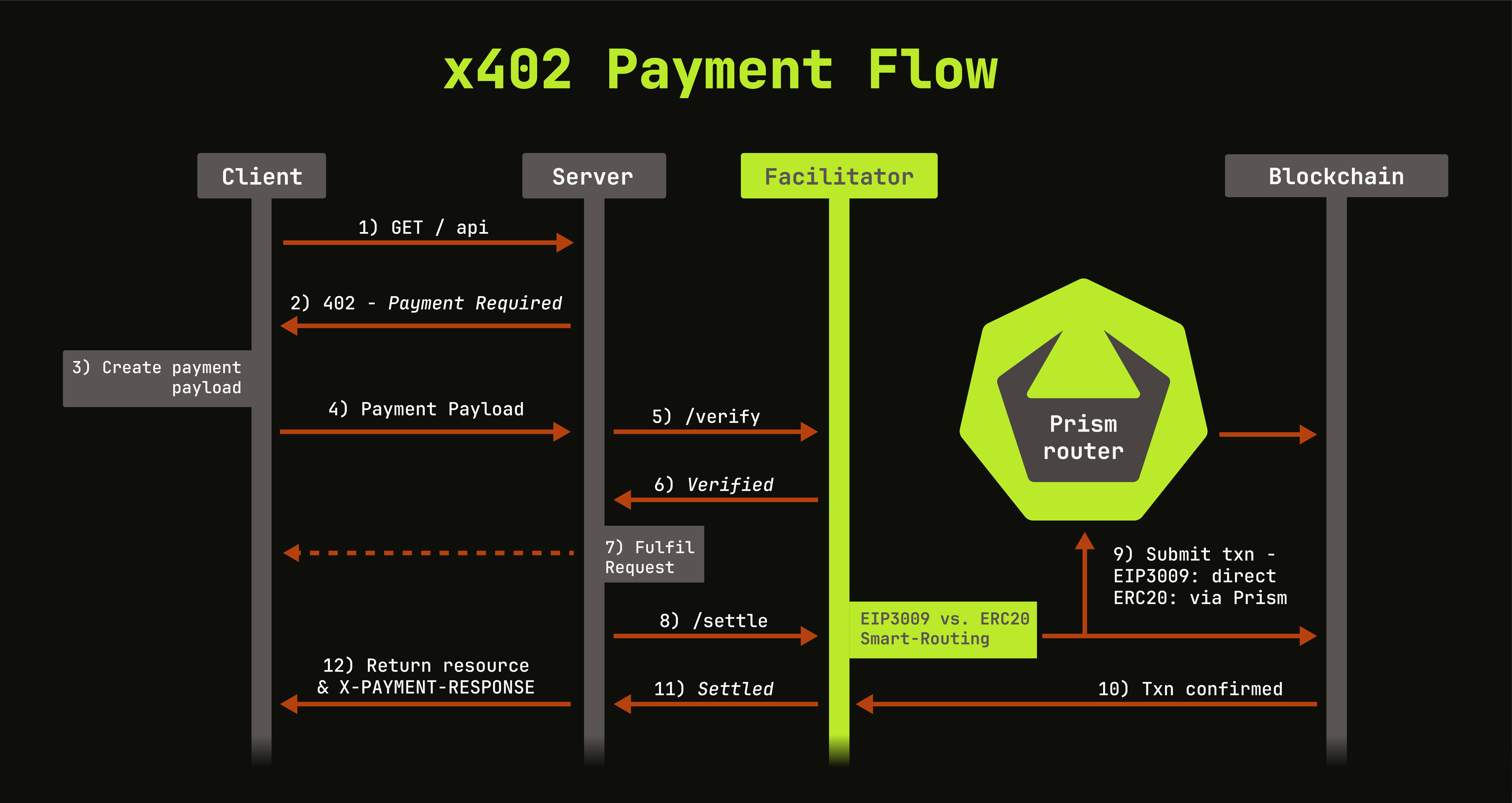
Payment Flow
- Client requests resource, server returns HTTP 402 + payment requirements
- Client signs EIP-712 authorization (no tx, just signature)
- Facilitator verifies signature, settles on-chain, sponsors gas
- Server delivers resource with tx receipt
[02]# Facilitator Integration
No signup, no API keys — just point your server at the facilitator URL below for verification and settlement of x402 transactions on Robinhood Chain, Base and SKALE Base. All x402 payment schemes are supported: exact, upto, and batch settlement.
x402 v1 & v2 capable, ERC-20 support, and fully compatible with smart-wallets.
[03]◆ Privacy Network
Standard x402 payments leave a trail; merchants see who paid, and the chain records the transfer. Primer's privacy architecture breaks that link through onion-routed requests and pooled settlement.
Agent-led privacy. The agent chooses whether to use privacy routing. Merchant receives a standard x402 payment – no special integration required.
Solver Mesh. 3-hop onion routing through $PR-staked relays. Entry knows WHO, exit knows WHAT, but neither knows both. Sentinels monitor for misbehaviour.
Federated Composers. Multiple independent operators correlate Entry/Exit signals via session token, validate balance against Dark Pool, and construct signed payment authorizations.
Decoy Flow. Staked operators generate cover traffic through the mesh, inflating the anonymity set even at low real volume.
Settlement. Facilitator submits Pool→Merchant settlement to the blockchain. On-chain shows Pool→Merchant, never Agent→Merchant.