


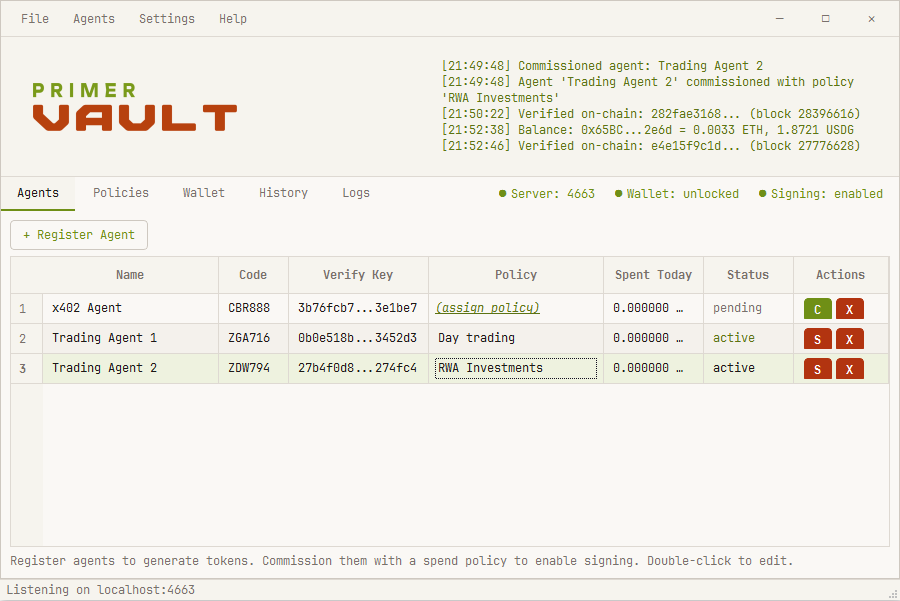
An agentic trading interface for RWA and tokens on Robinhood Chain. Run it on your desktop or from a USB, and Bring Your Own Agent (BYOA) — any model will work. Vault keeps your keys safely away from the agent, and gates trade requests according to your policies and controls. Link hundreds of agents, wallets and policies; your agent is the brains and Vault is the brawn.
Your agents don't need an audience.
[01]
#
x402_PRIVACY_ARCHITECTURE
Standard x402 payments leave a trail; merchants see who paid, and the chain records the transfer. Primer's privacy architecture breaks that link through onion-routed requests and pooled settlement.
Off-chain
On-chain
Data flow
Encrypted
Money flow
Service
Sentinel Nodes
Solver Mesh
Service
Federated Composers
Contract
$PR Staking
Contract
Fee Manager
Service
Decoy Flow
Input
Agent
Relay
Entry
Relay
Middle
Relay
Exit
Output
Merchant
Contract
Dark Pool
Service
Facilitator
Blockchain
[02]
=
HOW_IT_WORKS
Agent-led privacy. The agent chooses whether to use privacy routing. Merchant receives a standard x402 payment – no special integration required.
Solver Mesh. 3-hop onion routing through $PR-staked relays. Entry knows WHO, exit knows WHAT, but neither knows both. Sentinels monitor for misbehaviour.
Federated Composers. Multiple independent operators correlate Entry/Exit signals via session token, validate balance against Dark Pool, and construct signed payment authorizations.
Decoy Flow. Staked operators generate cover traffic through the mesh, inflating the anonymity set even at low real volume.
Settlement. Facilitator submits Pool→Merchant settlement to the blockchain. On-chain shows Pool→Merchant, never Agent→Merchant.
x402 settlement for the agentic economy.
[01]
#
INTEGRATION
No signup, no API keys — just point your server at the facilitator URL below for verification and settlement of x402 transactions on Robinhood Chain, Base and SKALE Base. All x402 payment schemes are supported: exact, upto, and batch settlement.
x402 v1 & v2 capable, ERC-20 support, and fully compatible with smart-wallets.
x402.primer.systems
<copy>
[02]
^
ACTIVITY
ONLINE
—
Transactions Settled
—
Total Volume Settled
—
Daily Buyers
—
Daily Sellers
LAST 24HRS
—
24h ago
now
LATEST TRANSACTIONS
○
Loading transactions...
Deflationary by design.
[01]
$
TOKEN_DETAILS
294,278,048
Max Supply (unclaimed 51% burned March '26)
-3,715,596
Buyback Burns
—
Total / Circulating (live)
— for —
Total PR Staked / Avg. Lock Time
>
Fair launch
No private sale, no public sale, no VCs.
>
100% circulating
No unlocks, vesting, or inflation. Supply is fixed; further changes are deflationary only.
>
Utility
Network fees (USDC, ETH) route to buybacks and staking rewards for Network Service operators. Operator slots are limited and require staking of $PR. Premium app features unlock with PR holdings.
>
Buybacks & Staking
Every trade strengthens the pool via automatic buybacks, and PR is routed to staking rewards. Pool fees and buyback rates adjust to market conditions.
Available on
{} Vault Win · macOS · Linux
 Docs
Docs
$ Primer Pay Chrome Extension
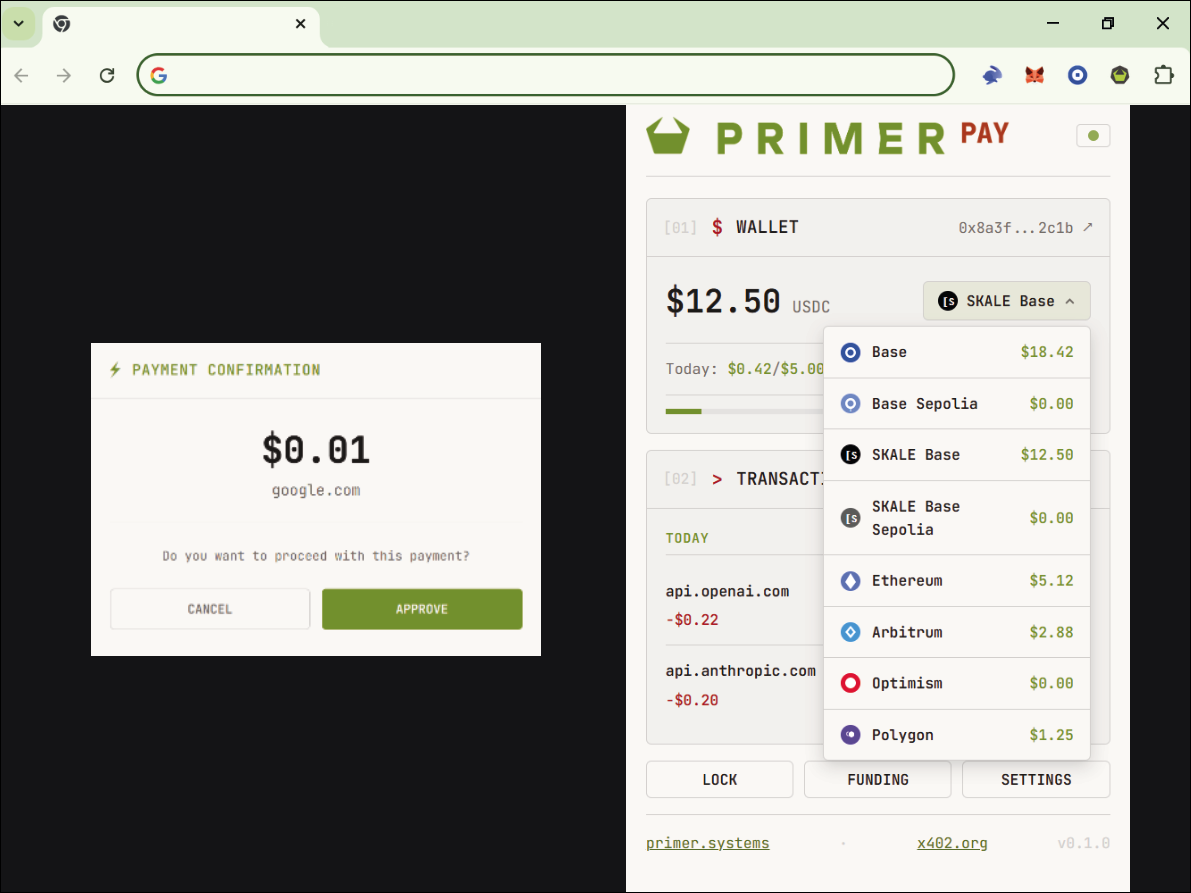
x402-enabled browsing on Chrome. Seamless micropayments, full spend controls and security. First of its kind.
¶ Primer for WordPress WordPress Plugin
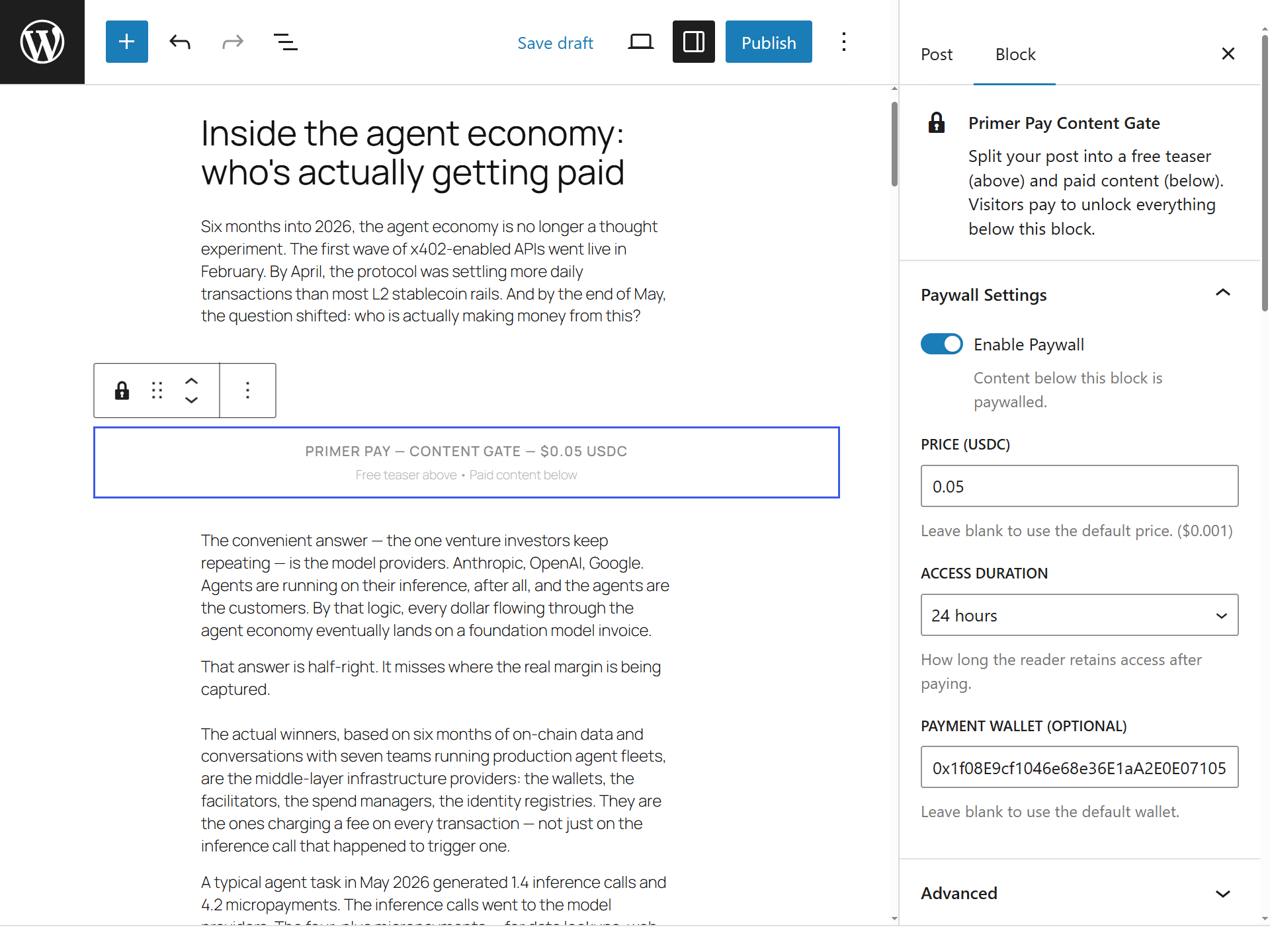
One-click x402 monetisation for posts and content. Native Gutenberg block, auto theme-matching, access controls, and agent discovery. Handles both human and agent consumers.
@ MultiClaw Win · macOS · Linux
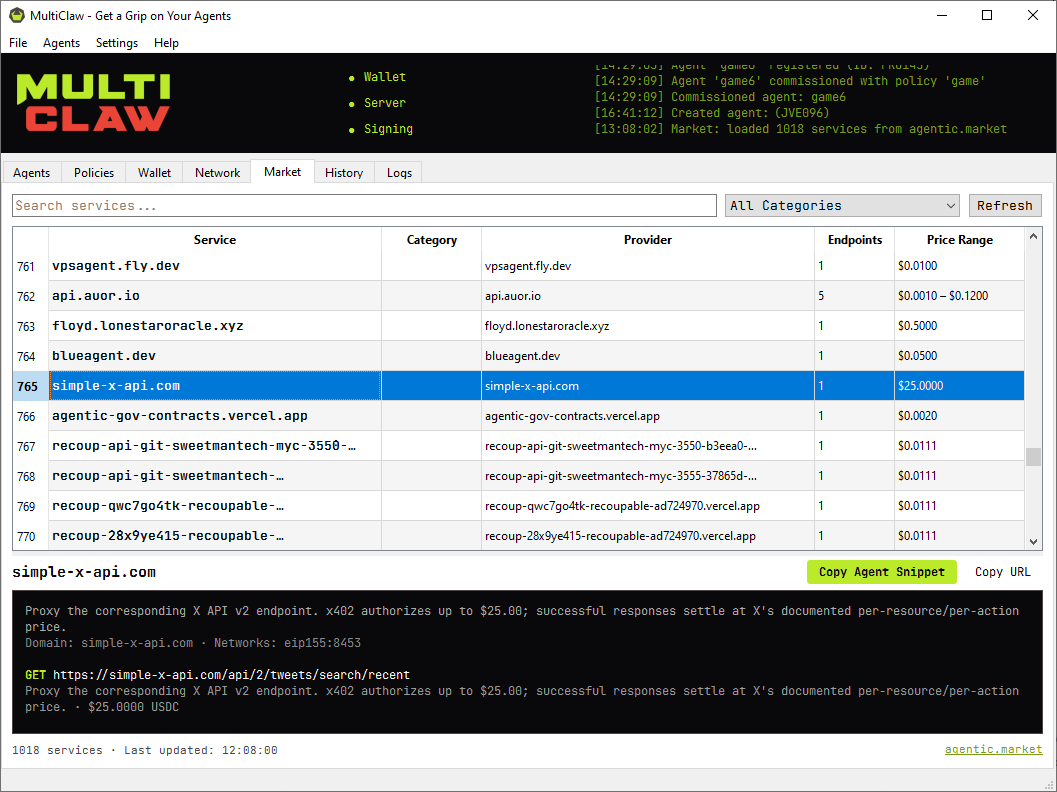
Get a grip on your agents! Secure multi-agent x402 manager with hard private key separation, spend controls, Google AP2 intents & receipts, and direct agentic.market integration to source services and APIs without leaving the app. Agent-agnostic; simple set up with any model. Runs on your desktop or direct from USB.
[01]
?
HOW_IT_WORKS
x402 is an open payment standard based around the HTTP 402 status, meaning Payment Required. This is in the same family as 404; Not Found. HTTP status codes were introduced in the 1990's, with 402 being intended for a then-unknown future payment system. In 2025, x402 unlocked this potential, allowing for gasless, instant settlement of agent-to-agent payments of any size.
Primer expands on the basic x402 offering with full ERC-20 support via the Prism router.
Payment Flow
1. Client requests resource, server returns HTTP 402 + payment requirements
2. Client signs EIP-712 authorization (no tx, just signature)
3. Facilitator verifies signature, settles on-chain, sponsors gas
4. Server delivers resource with tx receipt
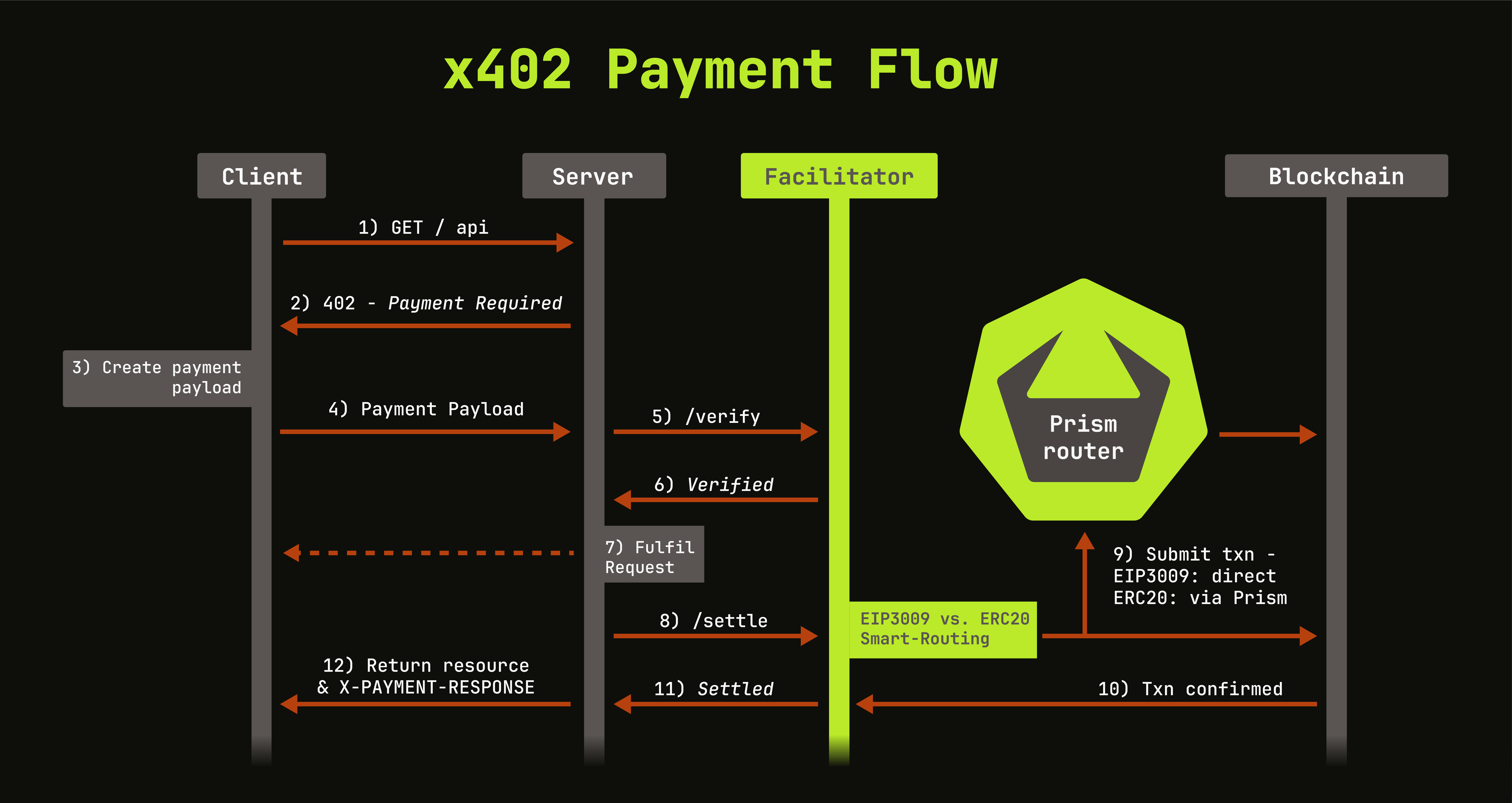
Read more: x402.org
[02]
+
LEARN_MORE
docs.primer.systems — Primer integration guides
[01]
?
OVERVIEW
Primer Systems builds payments and privacy infrastructure for the agentic economy. Our apps are available on Chrome Web Store, the WordPress Plugin Directory, and Win/MacOS/Linux.
Based in London, England, the team has been active in digital assets since 2013 and brings engineering, blockchain, and institutional finance experience to a domain that needs all three.
If you’re building something interesting or just want to discuss what we do, we’re always pleased to hear from you: dev@primer.systems
[02]
+
PARTNERS
We are proud to be in working partnerships with certain exemplary projects building in or adjacent to payments and privacy, including:

NØNOS
A post-quantum zero-state OS with anonymous networking. NONOS runs from USB and leaves nothing behind; an ephemeral, RAM-resident operating system for Cyberpunk privacy.
nonos.systems →
Sleuth Intel
Swarm intelligence for prediction markets and crypto on Robinhood Chain. Sleuth aggregates live on-chain activity, market contract data, trader behavior, and cross-market signals into a single platform that works equally well for human analysts and autonomous agents.
sleuthintel.io →
1Claw
1Claw is an HSM-backed secrets management platform purpose-built for AI agents. They give autonomous software a way to use credentials, sign transactions, and call external APIs without ever holding the raw key material.
1claw.co →
Blocktronics
An exhaustive suite of blockchain forensics tools that will help you make better trading decisions and optimise your DeFi strategies via accurate onchain account insights.
blocktronics.xyz →
Megalith
Agentic capital markets on litVM, the L2 for Litecoin. Tokenise agents into tradeable financial instruments, complete with dividends, governance, and more.
megalith.money →
[03]
◉
AFFILIATIONS
Primer benefits from membership of certain curated industry groups bringing together top-quality projects to foster cooperation and innovation:

Circle Alliance Program
Primer was admitted to the Circle Alliance Program following an application and qualification process, joining a global ecosystem of organizations building on and around USDC and Circle’s stablecoin infrastructure.
partners.circle.com →











[02]
■
COLORS
Lime
#baea2a
Rust
#E84536
White
#fafafa
Lime Dim
#7a9a1a
Rust Dim
#B7410E
Black
#09090b
[03]
A
TYPOGRAPHY
JetBrains Mono
[04]
!
USAGE
Use the green logo on dark backgrounds, black on light. Don’t stretch, rotate, or recolor the logo.
[02]
<
FOR_PROVIDERS
Use official @x402 middleware with Primer facilitator:
import { paymentMiddleware } from '@x402/express'
import { primerFacilitator } from '@primersystems/x402'

const routes = {
  '/api/premium': {
    price: '$0.01',
    network: 'eip155:8453', // Base
    payTo: '0xYourAddress'
  }
}

app.use(paymentMiddleware(routes, { facilitator: primerFacilitator() }))
[03]
#
FEATURES
Primer Facilitator — Pre-configured client for x402.primer.systems
Additional Networks — SKALE Base & Robinhood Chain
Prism Settlement — EIP-712 payloads for any ERC-20 token
CLI Scaffolding — Generate Bittensor/Chutes AI proxy projects
[02]
<
FOR_PROVIDERS
Use official x402 middleware with Primer facilitator:
from x402 import payment_middleware
from primer_x402 import primer_facilitator_sync

routes = {
    '/api/premium': {
        'price': '$0.01',
        'network': 'eip155:8453', # Base
        'payTo': '0xYourAddress'
    }
}

facilitator = primer_facilitator_sync()
app.add_middleware(payment_middleware(routes, facilitator=facilitator))
[03]
#
FEATURES
Primer Facilitator — Pre-configured client for x402.primer.systems
Additional Networks — SKALE Base & Robinhood Chain
Prism Settlement — EIP-712 payloads for any ERC-20 token
CLI Scaffolding — Generate Bittensor/Chutes AI proxy projects
[01]
?
VALIDATOR
The Primer Validator inspects any x402 endpoint — not just our own. Useful for testing your integration, debugging payment flows, education, and manual pre-agent checks.
[02]
#
TEST_PAYWALL_BUILDER
Generate custom x402 paywall endpoints for testing agent payment flows. Configure the network, amount, and recipient to create a paywall URL that returns 402 Payment Required.
[03]
◆
AP2_REGISTRY
Look up and examine Google AP2 Intent Mandates submitted via MultiClaw to ascertain an agent's spending permissions. New mandates may also be posted directly.